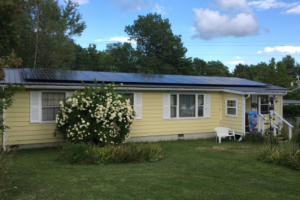

Most homes need a 6 kW to 10 kW solar system, which often works out to roughly 15 to 25 solar panels. But that is only a starting point. The right size for your home depends on how much electricity you use, how much sunlight your roof receives, your utility rules, your panel wattage, and whether you want to plan for future energy needs.
A solar system should not be sized by guesswork. A 2,000-square-foot home with gas heat may use less electricity than a smaller home with electric heat, older appliances, a workshop, or an electric vehicle charger.
That is why Solar Holler looks at your real electric usage, roof space, sun exposure, and energy goals before recommending a system. Solar should fit your home, not some national average.
Most Homes Need A 6 kW To 10 kW Solar System
Solar system size is measured in kilowatts, or kW. Your electricity usage is measured in kilowatt-hours, or kWh. A solar system’s kW size tells you how much power it can produce under strong conditions, while your kWh usage tells you how much electricity your home actually consumes over time.
For a quick planning estimate, many average homes fall into this range:
| Home Situation | Typical System Size | Estimated Panel Count |
| Smaller Home / Lower Usage | 3–5 kW | 8–14 Panels |
| Average Home | 6–10 kW | 15–25 Panels |
| Larger Home / Higher Usage | 10–15 kW | 25–40 Panels |
| Very High Usage / EV / Electric Heat | 15 kW+ | 40+ Panels |
For many Appalachian homes, the final number can land higher or lower depending on roof shape, shade, utility bill, and available space. We found that many home systems fall in the 20–40 panel range, depending on energy use and property fit.
Why Your Electric Bill Is Better Than Your Square Footage
Square footage can give you a rough starting point, but your electric bill tells a clearer story. Two homes of the same size can use very different amounts of electricity.
A family with electric heat, central air, multiple refrigerators, or an EV charger may need a much larger system than a similar-sized home with lower usage. That is why your monthly kWh use matters more than the size of your house.
How To Find Your kWh Usage
Look at your electric bill and find your monthly kWh usage. If you can, gather 12 months of bills so you can see your full year of electricity use.
Add the monthly kWh totals together, then divide by 12 to get your average monthly usage. This gives a better picture than only looking at one high or low month.
Why 12 Months Matters
Electricity use changes with the seasons. Summer cooling, winter heating, guests, holidays, home offices, workshops, and appliance use can all shift your monthly bill.
A full year of usage helps your solar designer size the system around your real home life. That leads to a more accurate design and a better long-term energy plan.
How To Calculate Solar System Size For Your Home
You do not need to be an engineer to understand the basic math. The simplest way to estimate system size is to start with your daily electricity usage and compare it to the amount of usable sunlight your home receives.
A basic formula looks like this:
Daily kWh Usage ÷ Peak Sun Hours = Estimated kW System Size
From there, most designs need some extra headroom for real-world conditions, equipment losses, shade, weather, and seasonal production changes.
Step 1: Find Your Monthly kWh Usage
Say your home uses 1,000 kWh per month. Divide that number by 30 to estimate daily usage.
1,000 kWh ÷ 30 = 33.3 kWh per day
That means your solar system would need to produce around 33 kWh per day to cover most of that usage before any design adjustments.
Step 2: Estimate Peak Sun Hours
Peak sun hours are not the same as daylight hours. They describe the strongest usable sunlight your panels receive during the day.
A sunny, open roof can produce more power from the same system than a shaded roof or a roof with less ideal orientation. In Appalachia, trees, hillsides, and roof angles can make this step especially important.
Step 3: Convert Usage Into System Size
If your home uses 33.3 kWh per day and your site receives about 4.5 peak sun hours, the rough system size would be:
33.3 ÷ 4.5 = 7.4 kW
Then you may add design headroom. If you multiply by 1.2, the practical system size becomes:
7.4 kW × 1.2 = 8.9 kW
Step 4: Convert System Size Into Panel Count
Solar panels are rated in watts. If your estimated system size is 8.9 kW, that equals 8,900 watts.
Using 400-watt panels, the math would be:
8,900 W ÷ 400 W = 22.25 panels
In real life, that would likely round to about 23 panels. The exact number may change based on the panel model, roof layout, and system design.
Solar System Size By Monthly kWh Usage
Monthly usage is one of the best ways to estimate solar system size. It gives a more accurate view than square footage because it shows what your household actually consumes.
Here is a general planning table:
| Monthly Usage | Rough Daily Usage | Estimated System Size | Estimated Panel Count |
| 800 kWh | 27 kWh/day | 6–8 kW | 15–20 Panels |
| 1,000 kWh | 33 kWh/day | 7–9 kW | 18–24 Panels |
| 1,500 kWh | 50 kWh/day | 11–14 kW | 28–35 Panels |
| 2,000 kWh | 67 kWh/day | 15–18 kW | 38–45 Panels |
| 4,000 kWh | 133 kWh/day | 30 kW+ | 75+ Panels |
A home using 4,000 kWh per month is a very high-usage property. In that case, a rooftop system may not have enough space to cover everything, so a ground mount or partial-offset design may be worth discussing.
Solar System Size By Home Square Footage
Home size can still help with early planning. It just should not be the only number used to size your system.
A small home with high electric usage may need more panels than a larger home with gas appliances and efficient systems. Still, this table can help you start the conversation.
| Home Size | Rough System Size | Estimated Panel Count |
| 1,000 sq ft | 3–5 kW | 8–14 Panels |
| 1,500 sq ft | 5–7 kW | 12–18 Panels |
| 2,000 sq ft | 6–10 kW | 15–25 Panels |
| 2,500 sq ft | 8–12 kW | 20–30 Panels |
| 3,000 sq ft | 10–15 kW | 25–40 Panels |
If you are asking how many solar panels you need for a 1,500-square-foot home, the answer may be around 12 to 18 panels. If you are asking about a 3,000-square-foot home, the range may be closer to 25 to 40 panels.
But the electric bill still matters most. That is the number your system should be designed around.
What Factors Change The Size Of Your Solar System?
A solar system is not sized from one detail alone. The best design balances your electric usage, roof space, sunlight, budget, utility rules, and future plans.
This is where a professional assessment matters. Online calculators are helpful, but they cannot see every roof, tree, ridgeline, or household habit.
Electric Heating And Cooling
Homes with electric heat, heat pumps, or heavy air conditioning may need more solar capacity. Heating and cooling can be some of the largest energy loads in a home.
If your winter or summer bills are much higher than the rest of the year, your system design should account for those seasonal peaks.
EV Charging
An electric vehicle can add a significant amount of monthly kWh usage. If you already have an EV or plan to buy one soon, mention that during your solar assessment.
It may make sense to size your system for the energy you expect to use, not just what you use today.
Pools, Workshops, Freezers, And Appliances
Pool pumps, large freezers, well pumps, workshops, hot tubs, and older appliances can all increase electricity demand. These details can shift your ideal system size.
A good solar design should reflect how your home actually runs, not just the number of people living there.
Roof Space And Roof Shape
Your roof may limit how many panels can fit. Vents, chimneys, skylights, dormers, roof planes, and setbacks can all reduce usable space.
If roof space is limited, higher-wattage panels may help. In some cases, a ground-mounted solar system may be worth considering.
Shade, Trees, And Appalachian Terrain
In West Virginia, Virginia, Kentucky, and Ohio, many homes sit near hillsides, wooded lots, and mature trees. That can affect sunlight across the day and across the seasons.
Solar Holler’s local experience matters here. A system designed for an open suburban roof may not be the same as one designed for an Appalachian hillside home.
Panel Wattage And Efficiency
Panel wattage affects how many panels you need. A 450-watt panel produces more power than a 350-watt panel, so fewer panels may be needed to reach the same system size.
That can be helpful when roof space is tight. But the best panel choice should still fit the roof, budget, production goals, and long-term system performance.
Do You Need To Offset 100% Of Your Electric Bill?
Many homeowners want to offset as much of their electricity use as possible. That can be a good goal, but it is not always required or practical.
Some homes do not have enough roof space for full offset. Others may choose a smaller system because of budget, utility rules, shading, or plans to expand later.
A partial-offset system can still reduce your dependence on the utility. It may also be a smart first step for homeowners who want to go solar now and revisit expansion in the future.
The right target depends on your goals. Some families want the maximum possible savings, while others want the best balance of cost, production, and monthly payment.
Should You Size Solar For Future Energy Needs?
Your current electric bill is the best starting point, but your future plans matter too. A system sized only for today may feel too small if your home’s energy use grows.
Think about whether you may add:
- An electric vehicle
- A heat pump
- Electric appliances
- A finished basement or home addition
- A home office
- Battery storage
These changes can increase your electricity use. If they are already on your horizon, talk about them before your system is designed.
Solar should be built around where your household is going, not only where it has been.
How Battery Backup Affects Solar System Size
Solar panels and batteries work together, but they are not sized the same way. Solar panel size is based on how much electricity your home needs to produce.
Battery size is based on how much backup power you want stored. Some homeowners want enough backup for essentials, while others want more whole-home support.
Solar Holler’s solar panels and battery technology highlights a range of battery storage options designed to help homeowners add resilience and backup power. A battery may not be necessary for every home, but it can be valuable if outages are a concern.
If your main goal is lowering your bill, a grid-tied solar system may be the right starting point. If your goal is both savings and backup power, battery storage should be part of the conversation.
How Solar Holler Sizes A System For Your Home
Solar Holler does not size your system from a national average alone. The team looks at your address, electric usage, roof layout, sun exposure, utility provider, budget, and ownership goals.
That process helps determine whether solar is a good fit and what system size makes sense. It also helps compare options like owning your solar system or going solar with no upfront cost, depending on availability and eligibility.
Solar Holler also helps Appalachian families understand what solar may cost for your home and how system size affects the final number. A larger system usually costs more, but it may also offset more electricity if your home needs it.
From design through Solar Holler’s installation process, the goal is simple: build a system that fits your roof, your usage, and your long-term energy goals.
FAQs About Solar System Size
What Size Solar System Do I Need For My Home?
Most homes need about a 6 kW to 10 kW solar system, but your actual size depends on your electric bill, roof space, sun exposure, panel wattage, utility rules, and energy goals.
A custom solar assessment is the best way to get an accurate system size for your home.
How Many Solar Panels Do I Need For 1,000 kWh Per Month?
A home using 1,000 kWh per month may need roughly a 7 kW to 9 kW solar system, or about 18 to 24 panels.
The final number depends on sunlight, roof layout, panel wattage, and how much of your bill you want to offset.
What Size Solar System Do I Need For 1,500 kWh Per Month?
A home using 1,500 kWh per month may need roughly an 11 kW to 14 kW system, or about 28 to 35 panels.
Homes with strong sun exposure may need fewer panels, while shaded properties may need more capacity.
What Size Solar System Do I Need For 2,000 kWh Per Month?
A home using 2,000 kWh per month may need around a 15 kW to 18 kW system, or about 38 to 45 panels.
If roof space is limited, a partial-offset design or ground-mounted system may be worth reviewing.
How Many Solar Panels Do I Need For A 1,500 Sq Ft Home?
A 1,500-square-foot home may need roughly 12 to 18 panels, but square footage is only a rough estimate.
Your electric bill is a better way to size the system because two homes of the same size can use very different amounts of power.
How Many Solar Panels Do I Need For A 3,000 Sq Ft Home?
A 3,000-square-foot home may need around 25 to 40 panels, especially if it has electric heat, high cooling needs, or EV charging.
A custom design will show whether your roof has enough usable space for that system size.
Can I Put Too Many Solar Panels On My Home?
Yes. An oversized system may cost more than it is worth if utility rules limit credits for extra production.
However, some homeowners intentionally size for future energy needs, such as EV charging or electric appliances.
Do I Need A Battery With My Solar System?
Not always. Batteries are useful for backup power and added resilience, but they are a separate sizing decision from the solar array itself.
Solar Holler can help you decide whether battery backup makes sense for your home and goals.
Find Out What Size Solar System Your Home Needs
Online estimates are useful, but your home deserves a real design. Your electric bill, roof, shade, utility provider, and future energy plans all shape the right solar system size.
Solar Holler can help you move from rough numbers to a clear plan. Explore your home solar options and request a free solar assessment to find out what size solar system makes sense for your home.